 Bring Your Own Game Master
A roguelike where your own AI is the game master
You type what your character does, and your AI decides what happens, as a game master does at a table. A small rules kernel rolls a d20 and keeps the hit points, so the GM can be inventive but can't cheat. Six floors, a boss at the bottom, and when the run ends, the GM writes its Chronicle: the story of your run.
This game costs us $0 per player. Your AI runs the dungeon.
Every ruling, floor summary and Chronicle runs on your own model: one on your computer, or your own Claude plan. It reaches the game through BYOLLM, a small free program. The game never learns which model you use, and there is no AI bill for us to pass on.
How it plays
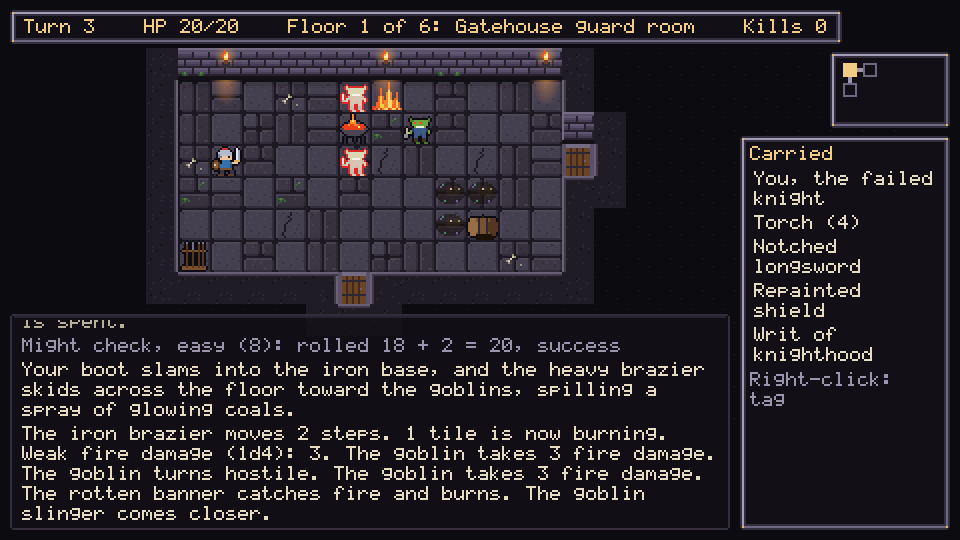
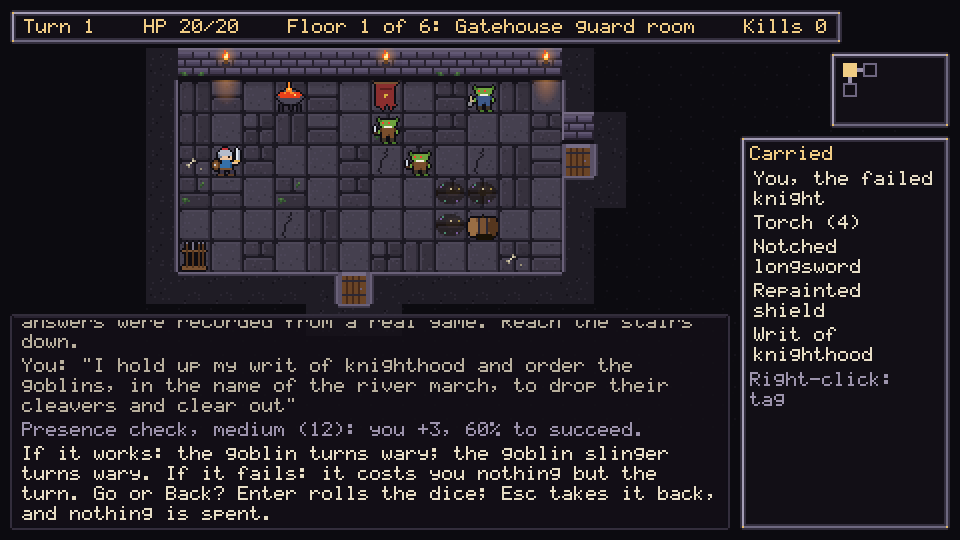
- Say what you doMove with the keys, and type anything else a person at a real table could try: kick the brazier at the goblins, talk your way past the troll, put the writ through his toll slot. Items and monsters are descriptions, not code, so a coil of rope can bind a door or trip an ogre.
- A d20 keeps it honestThe GM picks how hard a thing is and what it does. The game rolls the dice, does the sums and keeps the hit points. Before a roll you see the check: the stat, your chance, and what you stand to gain or lose. Go rolls it; Back takes it back.
- Six floors, then a ChronicleThree regions of two floors each: the undercroft, the old workings and the tally vaults. The Tallyman waits at the bottom of floor 6. Six backgrounds: three to start, and three more earned by reaching floor 3, reaching floor 5 and getting out alive. However the run ends, the GM writes its story.
A Chronicle
The end of one run's story, as Claude wrote it as the GM, word for word.
Beyond the armoury lay the gatehouse cells, and in them a giant rat. You threw your torch once more, and it struck the rat's flank in a spray of sparks and heat. But the torch was gone now, and you closed with your longsword instead. Your footing betrayed you on the straw, slick underfoot, and you went down hard. In the chaos the rat's teeth found your forearm.
You did not get back up. The giant rat killed you there in the gatehouse cells, on the first floor of the cellars, with one kill behind you and the torch burned out.
The failed knight, seed 1111, killed by the giant rat on floor 1. Written by Claude Sonnet as the GM, at the end of a run played by the game's test player.
Two ways in
The demo floor
Floor 1 as the failed knight, in your browser, with nothing to install. Every answer the GM gives was recorded from a real game, with Gemma 4 26B as the GM. Play along with the recorded player, or try the GM's other suggestions. Anything the recording has no answer for needs a GM of your own.
The whole game
All six floors, with your model as the GM. A whole run, played carefully, takes about half an hour; most end sooner. You need:
- A model. We tested Gemma 4 26B on llama.cpp, which runs on your own machine, and Claude through the
claudecommand-line tool with a Pro or Max plan. - BYOLLM on your computer, which needs Node.js.
The connect page walks you through it and sends one test ruling before you play.
For developers
BYOLLM
BYOLLM lets an app's users run its AI on their own models and their own subscriptions, through a small program they run and control. This game makes a model call on almost every turn, and it costs us nothing to offer. How to add it to a site, at docs.byollm.cloud.
Made with Argus
The game is built in Argus, a 2D game engine you build games in together with an AI agent. Every GM ruling is recorded input, so any run replays exactly without asking the model again. argusengine.org.